The Idea
An idea that has stuck with me in various forms since I started reading the machine learning literature has to do with the way that current connectionist systems1 lack a sort of ‘structured thinking’. It’s a very loosey-goosey intuition; can we improve these systems by giving them an inductive bias towards structured data?
This little experiment was my first (not very successful) attempt to explore this idea. It was also my first real foray into munging data and doing surgery on a model (the patient barely survived!).
I did this work in late 2022, just around the time that LLMs were starting to take off; it was still the era of using BERT and friends for NLP tasks. After stepping back from over-ambitious plans that I had no hope of executing (with my rudimentary skills), I came up with something more modest that I considered worth attempting.
I would pre-process input data with a standalone tool (the wonderful spaCy) to extract grammatical information about the input text, and then inject that information straight into the veins of a BERT model (I chose DistilBERT) to see how performance was affected.
The Experiment
Here’s a diagram showing dimensions of a single input to (vanilla) DistilBERT:
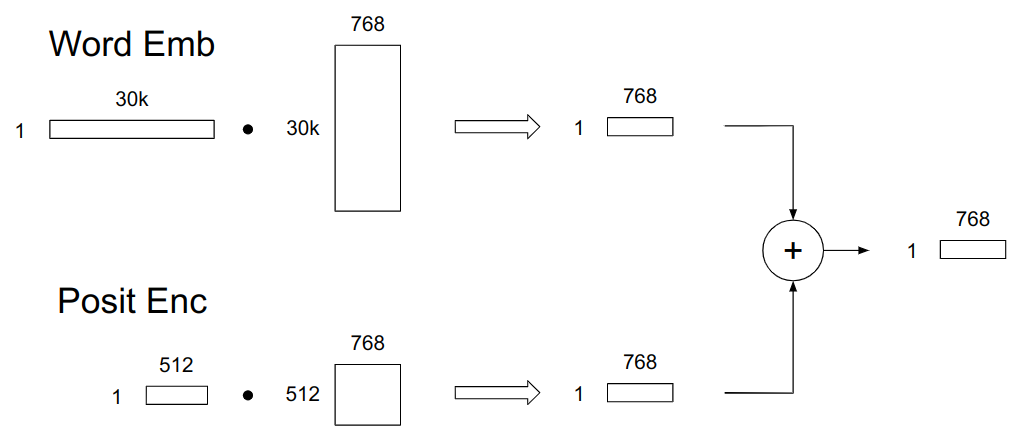
The idea was to modify this to also input grammatical information about the tokens, as in this diagram:
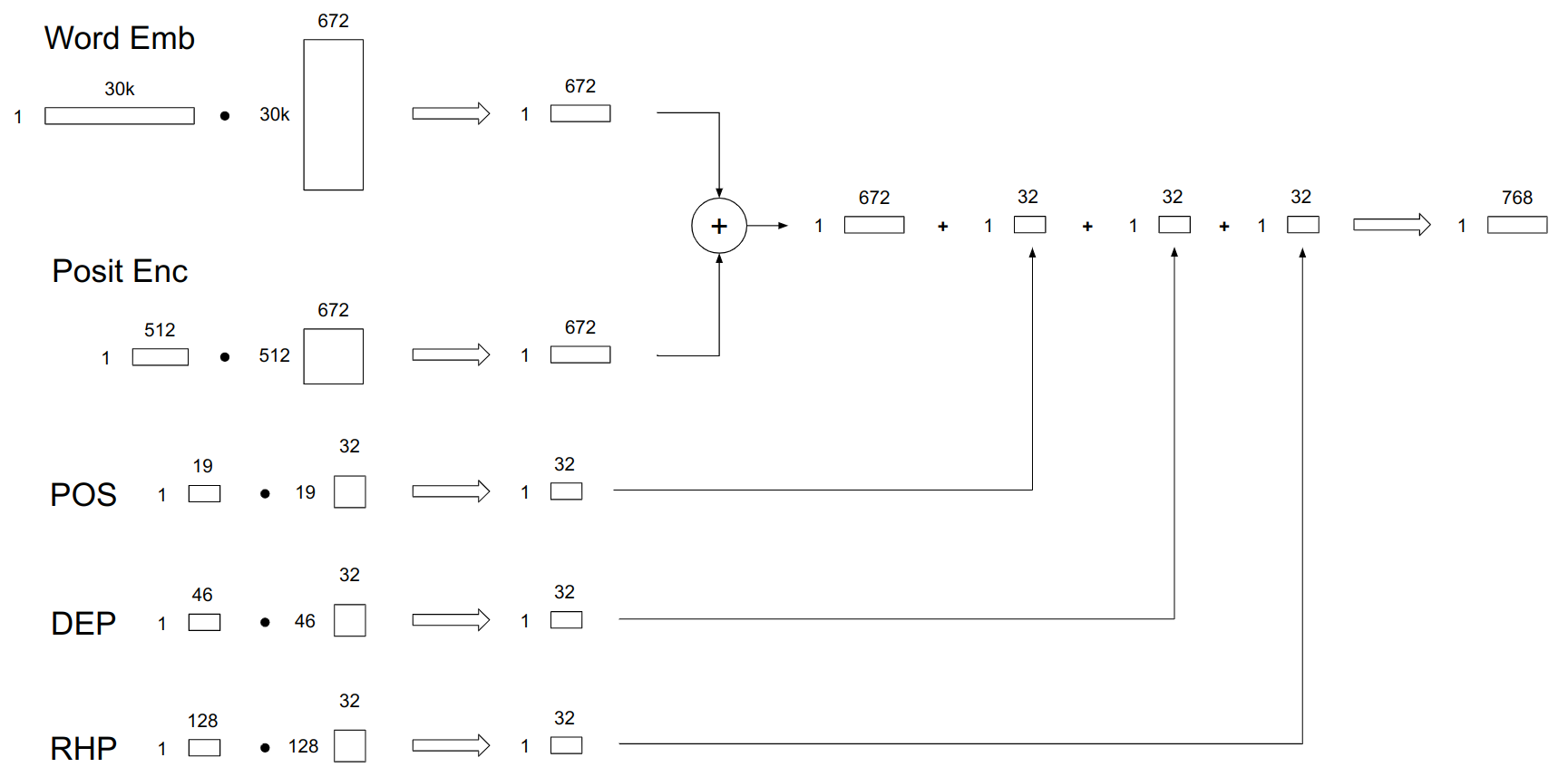
I decided to add three new fields, POS, DEP, and RHP, based on spaCy’s sentence diagram capabilities:
- POS: Part of Speech
- DEP: Dependency, the syntactic relation connecting child to head
- RHP: Relative Head Position, the (relative) position of the part-of-speech tag of the token head
I created a little dataset based on Flickr-8k, which consists of a set of photos together with multiple (human-generated) captions for each. For this work I ignored the photos and created pairs of randomly-selected captions from the dataset. The task was to predict whether or not the two captions corresponded to the same photo.
Here’s a positive example:
{'cap1': 'A man and a woman walk their dogs on leashes .',
 'cap2': 'Dogs straining on leashes towards each other , as owners walk apart on grass .',
 'label': 1}
Here’s a negative:
{'cap1': 'An old man in a black coat and hat leans against a brick building .',
 'cap2': 'Tall trees reach to the horizon as a cyclist navigates the way through the tangled roots .',
 'label': 0}
Let’s take that second caption above:
Dogs straining on leashes towards each other , as owners walk apart on grass .
Here’s the resulting sentence diagram from spaCy:

And this table shows the corresponding diagrammatic info that we feed into the model along with the normal tokens:
I_pos  Text           | POS      Dep      Head    Rel Head Pos
==============================================================
0      Dogs           | NOUN     nsubj    1       1
1      straining      | VERB     ROOT     1       0
2      on             | ADP      prep     1       -1
3      leashes        | NOUN     pobj     2       -1
4      towards        | ADP      prep     1       -3
5      each           | DET      det      6       1
6      other          | ADJ      pobj     4       -2
7      ,              | PUNCT    punct    1       -6
8      as             | SCONJ    mark     10      2
9      owners         | NOUN     nsubj    10      1
10     walk           | VERB     advcl    1       -9
11     apart          | ADV      advmod   10      -1
12     on             | ADP      prep     10      -2
13     grass          | NOUN     pobj     12      -1
14     .              | PUNCT    punct    1       -13
Some interesting side learnings:
- When you tokenize that sentence some of the words get split up in the usual manner, so there’s a little bit of management to keep the word-level information tied to the appropriate tokens.
- In order to use the pretrained DistilBERT (with some fine-tuning), I used PCA to do the reduction of embedding matrices from 768 to 672 (in the diagrams above). I also experimented with UMAP.
Results
My notes on this first experiment were embarrassingly sloppy.
The basic finding was that I saw roughly the same accuracy with and without this additional info being input to the model, but I don’t have numbers to report. After not seeing anything worth pursuing, I moved on to other things.
Takeaways
In retrospect, at the time I was quite naive about the capabilities models like BERT and how they learn. I recall realizing months later, to my surprise, that they actually learn things like grammatical information in the course of their self-supervised training.
Part of me still thinks that there’s something to the underlying idea (of somehow bringing more structure to these systems), but I’ve also seen that I have a tendency to fall prey to the Bitter Lesson…
Additional Thoughts
I don’t plan to make this repo public. When I wrote this code I was coming down a bunch of learning curves at once, and the work meandered over several months in a barely coherent fashion. And at the time I did not understand how best to inherit from Hugging Face classes, so I copied large swaths of the HF code and modified it. In retrospect, madness!
Footnotes
-
I’m using the term ‘connectionist’ here because—although its main use dates back to the ’70s—it nicely conveys the idea that I’m looking for here. ↩